Mirror Reflection and Paper Reflection (Transparent Glass and Frosted Glass)
When thinking of things that reflect light, mirrors probably come to mind first. Indeed, mirrors reflect over 90% of received light. On the other hand, white paper also has high reflectance, with ordinary copy paper having about 80%, and some types having reflectance as high as 90%. Comparing these two, the reflectance values are similar, but no matter how closely you look at paper, you cannot see yourself or surrounding scenery like in a mirror. This is because mirrors exhibit specular reflection while paper (whiteboard) exhibits diffuse reflection.
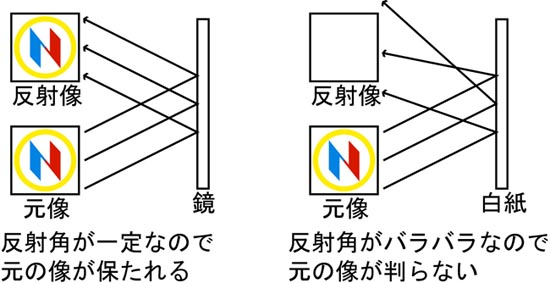
Specular reflection is a phenomenon where the angle of incidence and angle of reflection of light relative to the reflecting surface are the same. In the case of mirrors, specular reflection occurs at all positions of the extremely smooth mirror surface, allowing accurate viewing of the original incident image. On the other hand, in diffuse reflection, incident light is reflected in various directions due to fine surface irregularities, so while the light itself is reflected to a similar degree as mirrors, the image is distorted and the original shape cannot be discerned. Glossy paper is a state where specular reflection occurs in addition to diffuse reflection, and the higher the proportion of specular reflection, the glossier the paper becomes.
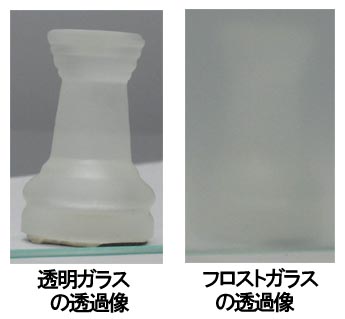
This state is similar when viewing objects through transparent materials like glass (transmitted image). In standard transparent glass, the proportion of light that passes straight through (parallel light transmittance) is high, so the scenery on the opposite side of the glass is visible as is, but in frosted glass, the proportion of light that diffuses and passes through (diffuse transmittance) increases due to surface irregularities, so while the light transmittance itself is unchanged from transparent glass, the image becomes blurred and difficult to see.